INET researchers developed a coupled numerical framework to quantify long-term graphite dust deposition on helium turbine blades and to evaluate how the evolving deposits influence film cooling performance. The work has been published in Progress in Nuclear Energy.
Xiaozhong Wang | INET news
August 2025
High-temperature gas-cooled reactors employ helium Brayton-cycle turbines to fully exploit high-temperature nuclear heat and enhance power conversion efficiency. However, the ingress of radioactive graphite dust from reactor core into the helium turbine may affect turbine performance. Therefore, it is necessary to investigate the long-term accumulation behavior of graphite particles under sustained operating conditions and to evaluate its impact on turbine performance.
To address the limited understanding of particle behavior in HTGR helium turbines—especially under the combined influence of film-cooling vortices and long-term accumulation—INET researchers proposed a long-term deposition modeling strategy that explicitly couples particle deposition/resuspension physics with surface-geometry evolution. The resulting methodology enables upper-limit prediction of deposition mass under varying particle sizes and blowing ratios, and offers a practical route for assessing deposition risks on film-cooled turbine blades.
Title and abstract of the paper
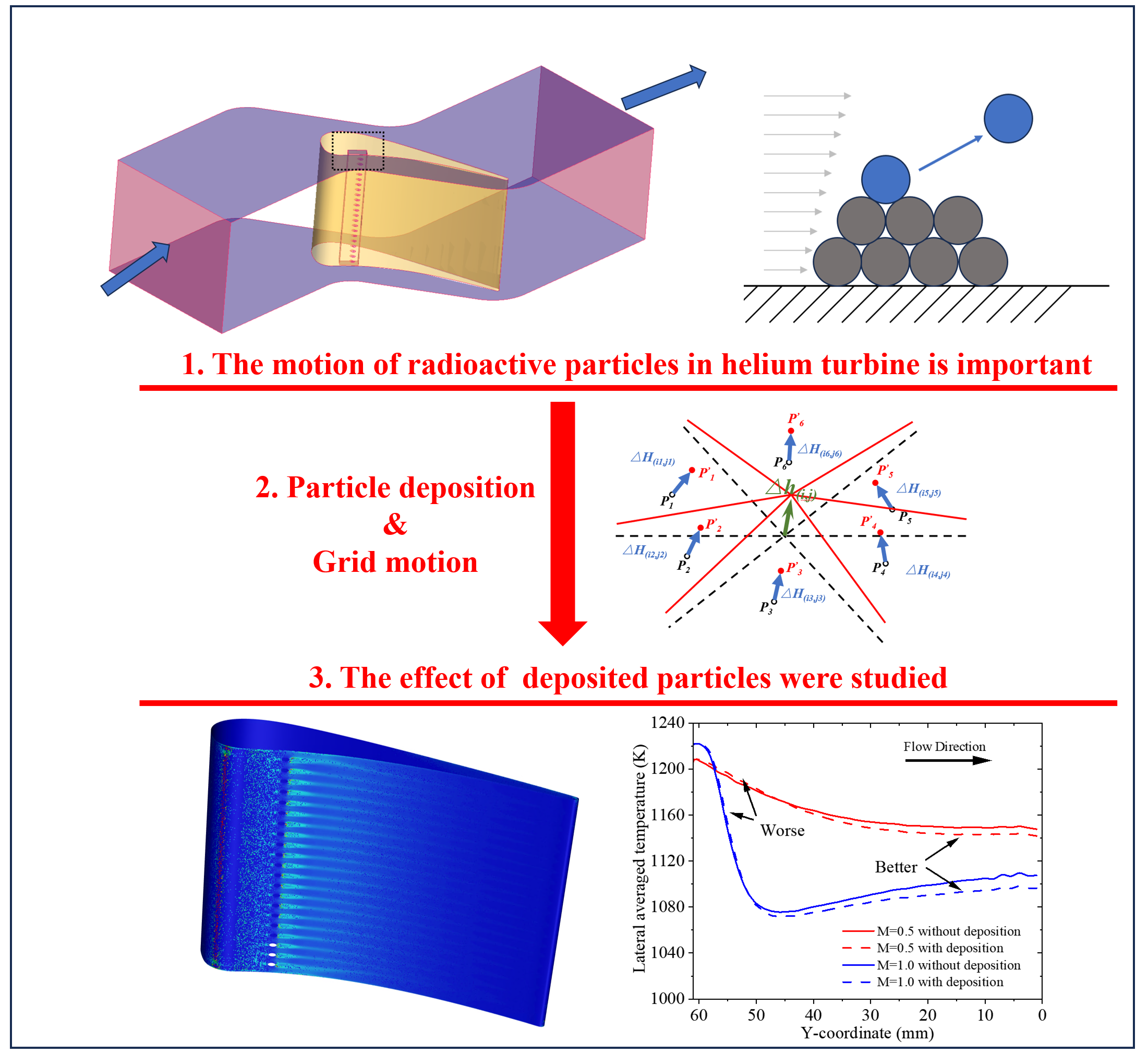
This study investigates the long-term deposition of spherical graphite particles on a film-cooled turbine blade and its impact on cooling performance by integrating Lagrangian particle tracking with a mesh deformation method. The particle–wall interaction framework accounts for rebound, adhesion, accumulation, and resuspension, and the deposit growth is fed back to the flow field through dynamic surface deformation. The results show that film cooling mainly affects the deposition distribution of smaller particles, and the long-term deposited mass decreases as the blowing ratio increases. Deposits are predicted to concentrate around film-cooling holes; deposition can impair cooling near the holes while enhancing cooling farther downstream, but the overall influence on cooling performance remains limited. Under the investigated conditions, 1μm particles cause a maximum deposition of no more than 56.56mg over 150days, and the blade temperature change induced by deposition does not exceed 10°C. A fast upper-limit prediction model for deposition mass across particle sizes and blowing ratios is further provided. Therefore, within the blade design life for comparable operating envelopes, graphite dust deposition is not expected to produce a noticeable degradation of turbine performance, with any deposition-related cooling perturbations remaining localized and modest rather than system-level limiting.
Link to access the full paper:
https://doi.org/10.1016/j.pnucene.2025.105798
