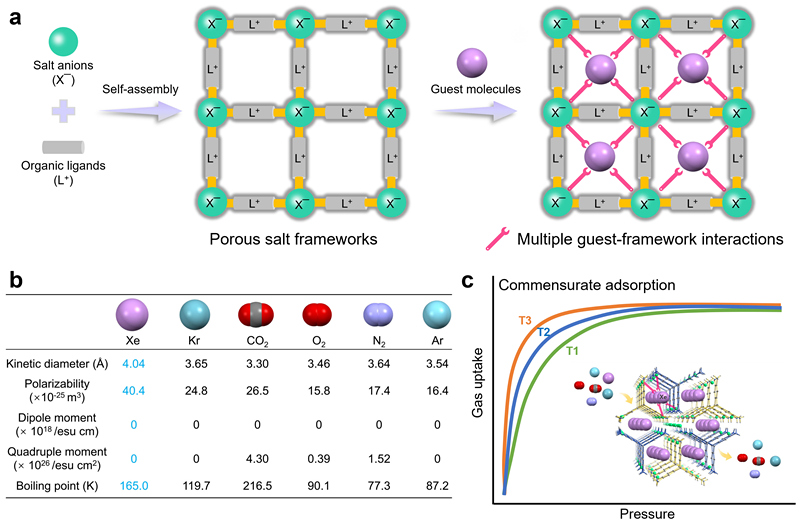
Efficient capture and separation of radioactive noble gases xenon (Xe) and krypton (Kr) represent a critical challenge in the field of spent fuel reprocessing (SFR). Researchers from the INET have developed a new class of non-metal porous organic salt frameworks, showing exceptional Xe/Kr separation ability based on the engineering of the guest-framework interactions.
XIE Yi | INET news
October 20, 2025
Background
The efficient capture and separation of radioactive noble gases xenon (Xe) and krypton (Kr) from spent fuel reprocessing to achieve zero emissions of radioactive vapors is of primary importance, but remains a crucial technical challenge due to their chemical inertness and fierce competition from air components. Adsorption-based separation using porous solid adsorbents is regarded as one of the most promising next-generation separation techniques. The burgeoning porous molecular crystals with permanent porosity in recent years offer a novel platform for demanding molecular separation. However, it is still of challenge to construct new porous molecular crystals with tunable pores and polar sites for the specific separation of Xe and Kr.
Highlights
Researchers have focused on the assembly of molecular crystals driven by multiple non-covalent bonds. By regulating the charge-assisted H-bonding assembly between rigid, D3h-symmetric triptycene scaffolds and spherical chloride anions, a novel porous ammonium halide salt (HAT_Cl) with distinctive 3D interconnected channels was rationally constructed, representing the first 3D porous ammonium halide salt. Particularly, the obtained 3D porous salt frameworks are featured by the precise pore size matching with the Xe atom and organized alignment of polar halide sites within the pore channels, showing an unusual, thermally-independent commensurate adsorption behavior for Xe under ambient conditions. As a result, the frameworks exhibited unparalleled dynamic Xe/Kr (20/80, V/V) separation performance, with a Xe uptake capacity of 1.47 mmol g-1 and a separation factor (SF) up to 10.2, breaking the trade-off between adsorption capacity and selectivity. Breakthrough experiments further demonstrated the real practical potential for Xe/Kr separation from the off-gas of used nuclear fuel reprocessing. Detailed computational simulations identified the presence of multiple strong Xe···Cl interactions as the driving force within the size-matching ionic channels of the salt framework.
Implications
The strategy of guest polarizability-directed commensurate “freezing” of noble gases within porous salt frameworks could be applied in challenging Xe separation from the spent fuel reprocessing off-gas. Guidance is established for the design of advanced porous materials to address the trade-off between adsorption and selectivity. This work was published in the Angewandte Chemie International Edition, with the title "Guest Polarizability Directed Molecular "Freezing" Within Non-metal Porous Salt Frameworks", and was selected as a Very Important Paper.
Link to access the full paper
https://onlinelibrary.wiley.com/doi/10.1002/anie.202509905
