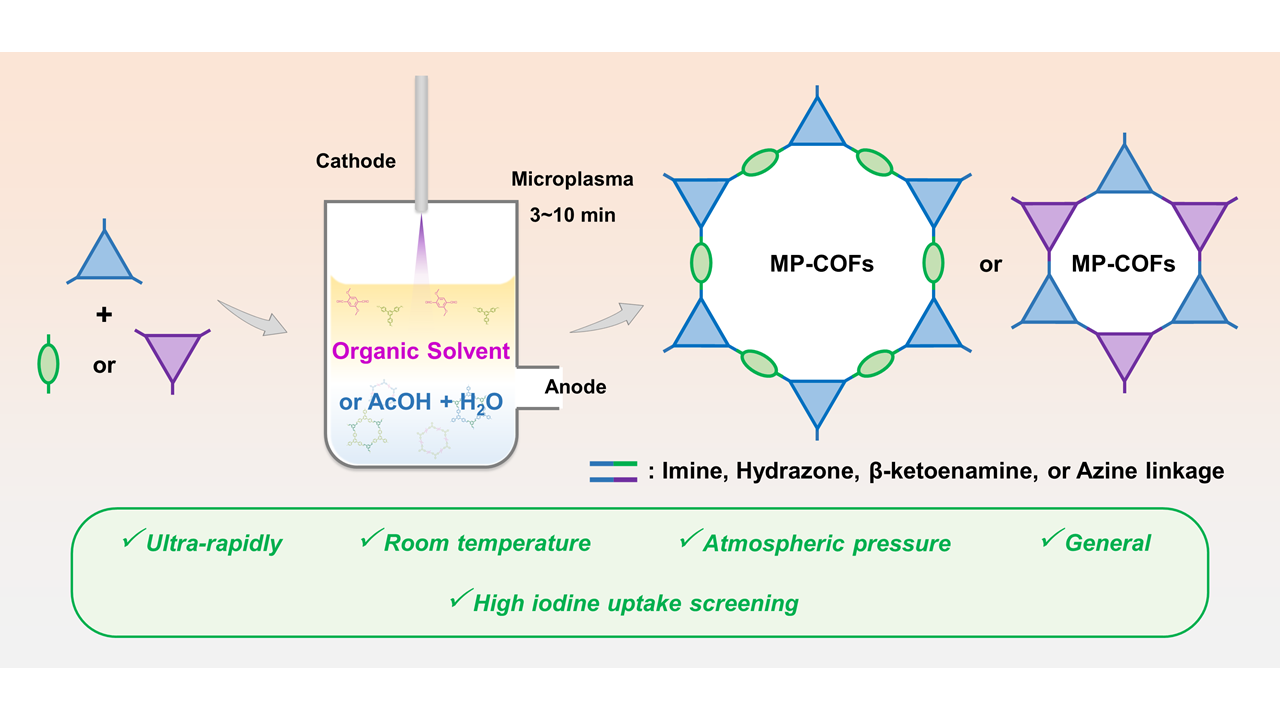
Capturing volatile iodine isotopes is crucial due to their long half-lives and potential impact on human health and the environment. Recently, researchers from INET have developed a fast-screening platform based on microplasma electrochemistry (MIPEC) method to discover the potential covalent organic frameworks (COFs) candidates for iodine capture.
Background
As one of the most concerning radionuclides, iodine isotopes (129I and 131I) have drawn increasing attention because of its toxicity, radioactivity, and long half-life (∼1.57 × 10⁷ years for 129I). Various adsorbent materials have been explored for I2 adsorption, such as inorganic materials, porous organic polymers (POPs), and metal-organic frameworks (MOFs). As a class of emerging crystalline materials, covalent organic frameworks (COFs) are an ideal I2 adsorbent because of their high surface area, high stability, rich nitrogen content, and structural designability. However, many challenges remain in the synthesis of COFs for efficient iodine capture.
Highlights
INET researchers have developed a rapid microplasma electrochemistry (MIPEC) method for synthesis and screening of COFs for highly efficient iodine capture. A series of flexible imine-bond COFs with various monomers in minutes at room temperature,which showed 1000-fold higher space-time yield than solvothermal method.This approach also achieved the preparation of COFs with diverse linkages and four types of imine-based COFs were successfully synthesized in aqueous acetic acid, which avoided the use of harmful organic solvents, indicating that microplasma method is green and versatile for COF synthesis. The generation of ROS reactive oxygen species induced by plasma is a key factor driving the reaction, while the crystal regulation of water synergistically ensures the high crystallinity of COFs. The obtained COFs showed higher surface area and exhibited superior performance in volatile iodine uptake. After screening more than ten types of COFs, the iodine adsorption capacity could be promoted from 2.81 to 6.52 gg-1. The results in our work indicated that, for MP-COFs with the same monomers, the better crystallinity and larger surface areas of those COFs were profit to the diffusion of iodine molecules and provides more binding sites, leading to the enhanced adsorption performance. For MP-COFs with the distinct monomers or structures, the chemical adsorption effects overweighed the influence of physical structures.
Implications
MIPEC as a rapid synthesis-screening strategy provided valuable insights and references for the design and relevant research of COFs with high iodine adsorption performance. Furthermore, the rapid and versatile MIPEC method is also well suited for screening COFs in various specific application scenarios beyond iodine uptake. This work was published in the Nature Communications, with the title "General synthesis of covalent organic frameworks under ambient condition within minutes via microplasma electrochemistry approach", and was selected as a Highly Cited Papers.
Link to access the full paper
https://doi.org/10.1038/s41467-025-57892-6
